
6 February 2026
According to the biography by Diogenes Laertius, Pythagoras (c. 570–c. 490 BCE) ‘held that the most beautiful figure is the sphere among solids, and the circle among plane figures’.1
This aesthetic preference for the circle and sphere can be traced through thinkers like Plato (who, according to later writers, set the problem of describing the movements of the heavens using uniform circular motions), Cicero (106–43 BCE),2 and Proclus (410/12–485 CE), and into the middle ages.3
Thomas Bradwardine (1290/1300–1349), one of the mediaeval ‘Oxford calculators’, was obviously influenced by this tradition when he wrote that the circle ‘is the first and most perfect of figures, the simplest and most regular, the most capacious and the most beautiful of figures’.4
But Bradwardine then presented evidence that he saw as attesting to the beauty and perfection of the circle: (1) the construction to find the centre of a circle by bisecting a diameter found as the perpendicular bisector of a chord; (2) that the intersections of six equally-spaced radii with the circumference define a regular hexagon; (3) that exactly six circles of equal size can touch a given circle.
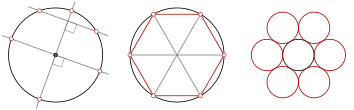
For Bradwardine, the perfection of the circle was thus linked to the perfection of the number $6 = 1+2+3$: the construction involves six intersections with the circle; the hexagon is made up of six lines; the third result involves six outer circles.3
Diogenes Laertius, ‘Pythagoras’. In: ‘Lives of Eminent Philosophers’, vol.II: Books 6–10. Loeb Classical Library, no.185. Cambridge, MA: Harvard University Press, 1925. DOI: 10.4159/DLCL.diogenes_laertius-lives_eminent_philosophers_book_viii_chapter_1_pythagoras.1925. Meibomius 8.35. ↩
Cicero. ‘De Natura Deorum.’ In: Loeb Classical Library, no.268. Cambridge, MA: Harvard University Press, 1933. DOI: 10.4159/DLCL.marcus_tullius_cicero-de_natura_deorum.1933 § II.xviii ↩
A. J. Cain. Form & Number: A History of Mathematical Beauty. Lisbon, 2024. pp. 44, 61–2, 128–9, 153, 182. ↩ ↩2
A. G. Molland. ‘An Examination of Bradwardine’s Geometry’. In: Archive for History of Exact Sciences. 19, no. 2 (1978). DOI: 10.1007/BF00328611 p. 143. ↩