
9 February 2026
Abū Sahl al-Kūhī (= al-Qūhī; fl. c. 970–c. 1000), who was regarded by contemporaries as the ‘Master of his age in the art of geometry’,1 once wrote of his motivation for considering a problem:
‘Having completed the construction of a regular heptagon in a circle, we set out to investigate another proposition, one more beautiful [ʾaḥsan أحسن], deeper, more opaque and more difficult to find out than the construction of the heptagon […]. This is the construction of an equilateral pentagon in a known square.’2
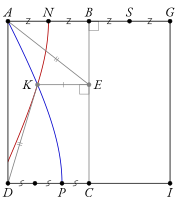
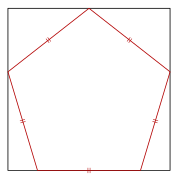
Al-Kūhī’s construction is shown in the diagrams. The top edge of the square $AGID$ is divided into quarters at $N$, $B$, $S$. The midpoint of the bottom edge is $C$. The point $P$ is two-thirds of the way from $D$ to $C$. The two curves in red and blue are hyperbolae are shown, both with latus rectum equal to $2AG$. The first has major axis $NS$. The second has latus rectum $PI$ and so passes through $P$ and curves up and left through the square. They intersect at $K$. A horizontal line through $K$ meets $BC$ at $E$. The segments $DK$ and $AE$ are both equal to the required sides of the pentagon and have the correct orientation, so a simple translation moves them into position.
(Note that the pentagon is only equilateral, not equiangular, and so is not regular.)
Al-Kūhī referred to the greater beauty of this construction compared to an earlier one he found using the intersection of a parabola and a hyperbola.
The greater beauty may be partly due to the greater overall simplicity of the construction, or the use of two conic sections of the same species — hyperbolae — instead of two different species — a parabola and a hyperbola.3
In other works, al-Kūhī reflected on the importance of mathematical beauty. Archimedes was honoured in part because of the beauty of his work:
‘Mathematicians agree in recognizing Archimedes is eminent and holds first place among the Ancients, because they have taken note of how many beautiful and advanced things he discovered, and ⟨how many⟩ difficult and abstruse propositions, in the highly valued demonstrative sciences’.4
And
‘philosophers are more proud of the sciences of the mathematicians than of the sciences of other ⟨scholars⟩, because of their beauty, their truth, their absence of delusive imagination, the proofs they afford, their lack of connections with religions and power, and their disdain for rhetoric and language’.5
Note that al-Kūhi mentioned beauty first, prioritizing the aesthetic over the aletheic and epistemic.
J. L. Berggren. ‘Tenth-Century Mathematics through the Eyes of Abū Sahl al-Kūhī’. In: J. P. Hogendijk & A. I. Sabra, eds. The Enterprise of Science in Islam: New Perspectives. Dibner Institute Studies in the History of Science and Technology. The MIT Press, 2003. ISBN: 978-0-262-19482‑2. p. 178. ↩
Al-Qūhī. ‘On the Construction of an Equilateral Pentagon in a Given Square’. In: Rashed. Geometry and Dioptrics in Classical Islam. p. 532. ↩
A. J. Cain. Form & Number: A History of Mathematical Beauty. Lisbon, 2024. pp. 205–7. ↩
Al-Qūhī. ‘Treatise on the Construction of the Side of the Regular Heptagon Inscribed in the Circle’. In: Rashed. A History of Arabic Sciences and Mathematics, vol. 3. p. 651. ↩
Al-Qūhī. ‘On the Determination of the Division of a Known Angle into Three Equal Parts’. In: R. Rashed, Geometry and Dioptrics in Classical Islam. London: al-Furqān Islamic Heritage Foundation, 2005. ISBN: 978-1-873992-99‑9. p. 494. ↩