
3 October 2025
The #Mathober 2025 day 3 prompt is ‘Polyhedron’. I thought I would use the occasion to draw attention to a lesser-known role of polyhedra in Johannes Kepler’s (1571–1630) thought.
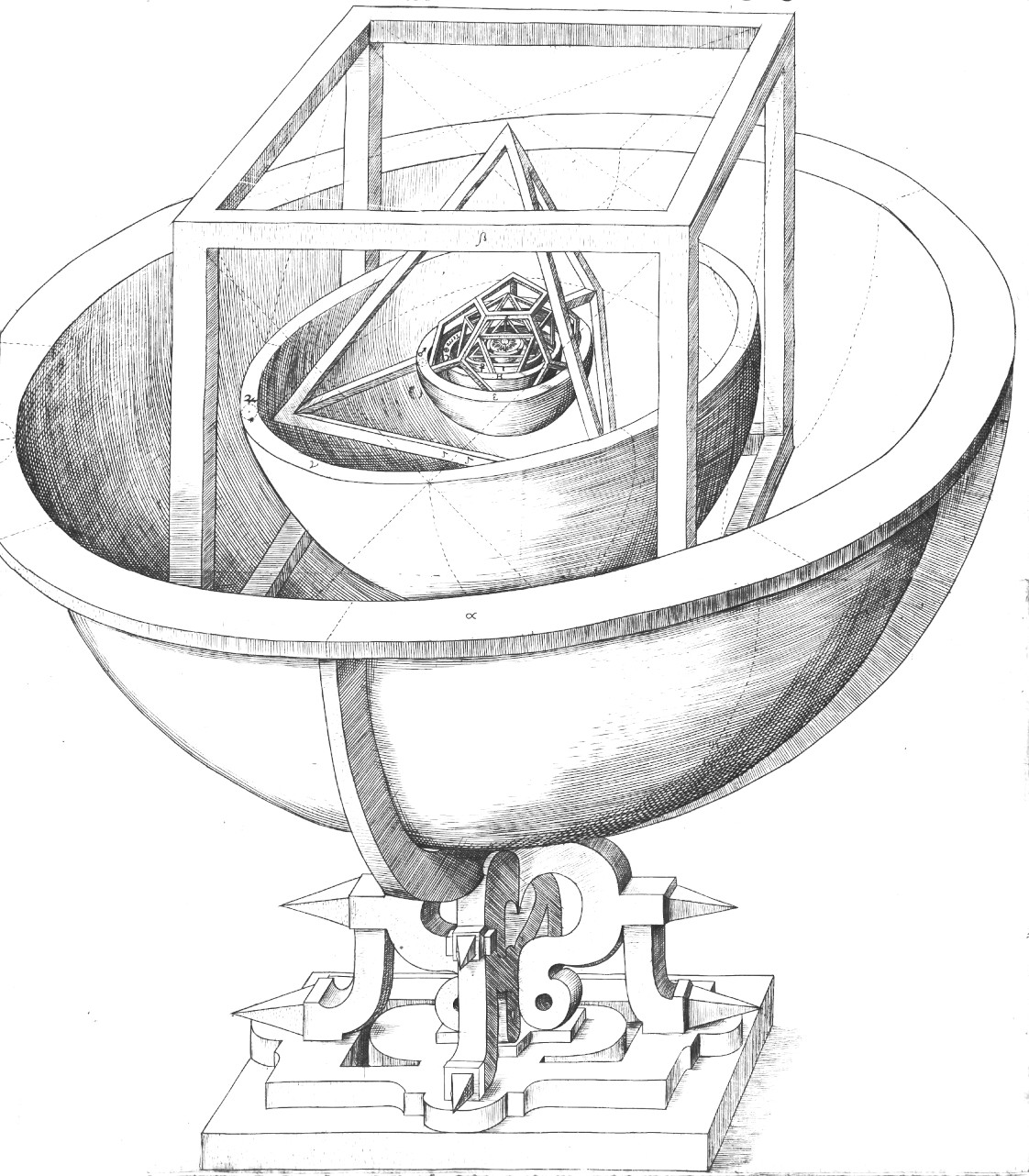
Start with the famous part: Kepler argued that the five regular (or Platonic) solids fitted between the orbs of the then-known six planets:
When Galileo discovered four moons of Jupiter, Kepler sought a similar polyhedral structure for the Jovian system, and suggested that ‘semiregular’ solids provided the key. ‘Semiregular’ for Kepler meant that the polyhedra had rhombic faces and satisfied certain technical criteria. (The concept differs from today’s notion of semiregular polyhedra.)
There were exactly three such ‘semiregular’ polyhedra:
the cube (the square being a special kind of rhombus);
the rhombic dodecahedron (12 faces):


Kepler placed the rhombic dodecahedron between Io and Europa, the rhombic triacontahedron between Europa and Ganymede, and the cube between Ganymede and Callisto.
Kepler thought that there were six planets because God had shaped the cosmos around the five platonic solids. The three ‘semiregular’ solids would similarly explain why there were four moons of Jupiter.
J. V. Field. Kepler’s Geometrical Cosmology. Bloomsbury, 2013. ISBN: 978-1-4725-0703‑7. pp. 79–80, 218–19.
J. Kepler, Gesammelte Werke, vol. VII: Epitome Astronomiae Copernicanae. Edited by M. Caspar. Munich: C. H. Beck, 1953. pp. 318–19.
A. J. Cain, Form & Number: A History of Mathematical Beauty. Lisbon, 2024. pp. 292–3.
Kepler’s diagram from, Mysterium Cosmographicum (1621), pl. following p. 26. [Public domain]
Diagrams of polyhedra from Form & Number, figure 8.27.