
1 February 2026
For each day of February, I intend to post a short interesting story/image/fact/anecdote related to the aesthetics of mathematics. February has $28$ days, and $28$ is the second perfect number, so let’s start there.
Definitions first: a perfect number is equal to the sum of its own proper divisors ($28 = 1+2+4+7+14$). If the sum of proper divisors is greater than the number itself, the number is abundant; if less, it is deficient.
Philo of Alexandria ( fl. early 1st century CE) seems to have connected perfect numbers with beauty, at least via the order emplaced in the world during the Biblical $6$ ($= 1+2+3$) days of creation. (The perfect number of days of the hexaëmeron was emphasized by later writers like Methodius of Olympus (d. c. 310 CE) and Augustine of Hippo (354–430 CE), though not in explicitly aesthetic terms.1)
Nicomachus of Gerasa ( fl. 100 CE) seems to have thought that the (rare) perfect numbers were beautiful, and that the much more common abundant and deficient numbers were ugly, likening them to monstrous creatures with too many or too few limbs, mouths, eyes.2
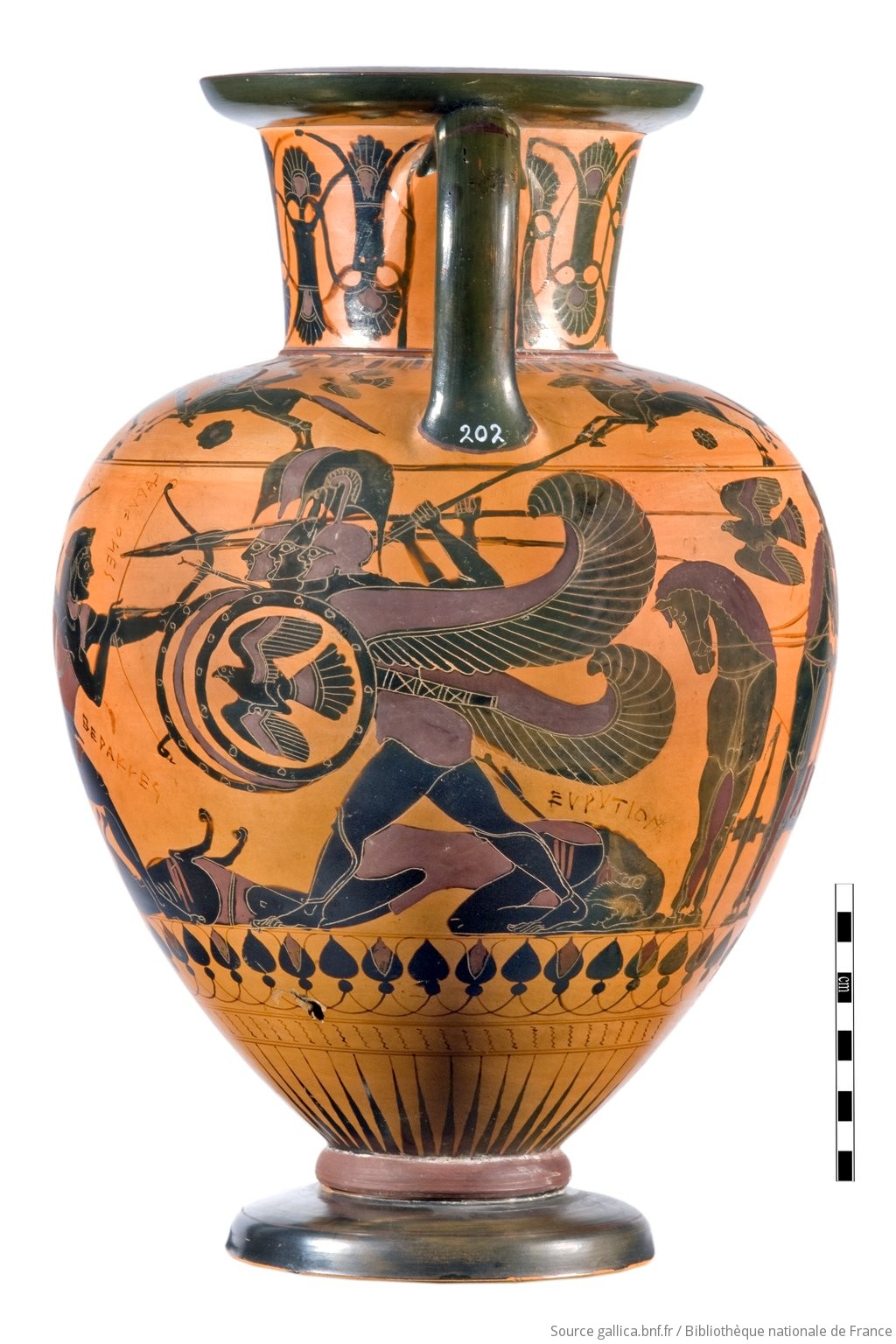
Boethius (c. 480–c. 524 CE) agreed with Nicomachus and was even more specific about the parallel to monsters: deficient numbers were like the one-eyed Cyclopes; abundant numbers were like the triple-headed or -bodied Geryon (illustrated on the above amphora).3
A. J. Cain. Form & Number: A History of Mathematical Beauty. Lisbon, 2024. pp. 139–40, 167–8. ↩
Nicomachus. Introduction to Arithmetic. Trans. by M. L. D’Ooge. University of Michigan Studies: Humanistic Series, no. XVI. New York: Macmillan, 1926. §§ I.14–16. ↩
Boethius, De Institutione Arithmetica Libri Duo. De Institutione Musica Libri Quinque. Edited by G. Friedlein. Leipzig: B.G, Teubner, 1867. § I.19. ↩