
2 February 2026
The Conics of Apollonius of Perga (c. 260–c. 190 BCE) became the standard text for conic sections — the curves formed by the intersection of a plane and a cone, namely an ellipse, parabola, or hyperbola, depending on the angle of the plane relative to the slope of the cone.
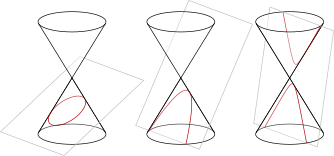
In the preface to the Conics, Apollonius wrote:
‘The third book contains many incredible theorems of use for the construction of solid loci and for limits of possibility of which the greatest part and the most beautiful [kallista κάλλιστα] are new.’1
This quotation is triply important in the historiography of mathematical beauty: (1) it is the earliest extant description of a mathematical theorem as ‘beautiful’; (2) it is the earliest extant application of the term ‘beautiful’ to mathematics by a mathematician; and (3) it is the unique extant use of the term ‘beautiful’ to describe theorems by an ancient Greek mathematician.2
(There is much discussion of the beauty of mathematics in ancient Greek thought, but it normally applies to the objects or concepts of mathematics.)
The results Apollonius referred to are those necessary for the three-line and four-line locus. In modern terms, a three-line locus is the set of points whose distances $d_1$, $d_2$, $d_3$, $d_4$ to four given straight lines satisfy an equation $d_1 d_2 = k d_3 d_4$ for some given $k$. A three-line locus is the set of points where the distances satisfy an equation $d_1 d_2 = k d_3^2$. These loci are always conic sections.3
Apollonius. Coniques: Texte grec et arabe établi, traduit et commenté. Edited by R. Rashed. Berlin & New York: Walter de Gruyter, 2008–10. vol. 1.2, p. 4. ↩
R. Netz. ‘What did Greek Mathematicians Find Beautiful?’. In: Classical Philology. 105, no.4 (October 2010) E. Asmis, editor, Beauty, Harmony, and the Good, pp.426–444. DOI: 10.1086/657029. ↩
A. J. Cain. Form & Number: A History of Mathematical Beauty. Lisbon, 2024. chs 2–4, but esp. pp. 113–15. ↩