
3 February 2026
Max Dehn (1878–1952) said that Archimedes’ (c. 287–212 BCE) discovery that the surface area of a sphere was four times its great circle was the one of the most beautiful results of Greek mathematics.1
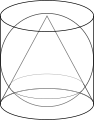
Archimedes himself had a high opinion of this result and two others in his two books On the Sphere and the Cylinder: that the volume and surface area of a sphere and a cylinder exactly circumscribing it are in the ratio $2 : 3$. One can add a cone fitting inside the cylinder to have ratios $1 : 2 : 3$ (see diagram).2
It has been suggested that Archimedes’ conjectures for these ratios may have been guided by a conscious or unconscious search for beautiful integer ratios between geometric configurations. There is no direct evidence for this motivation, but Archimedes’ work seems to exhibit a preference for small integer ratios.34
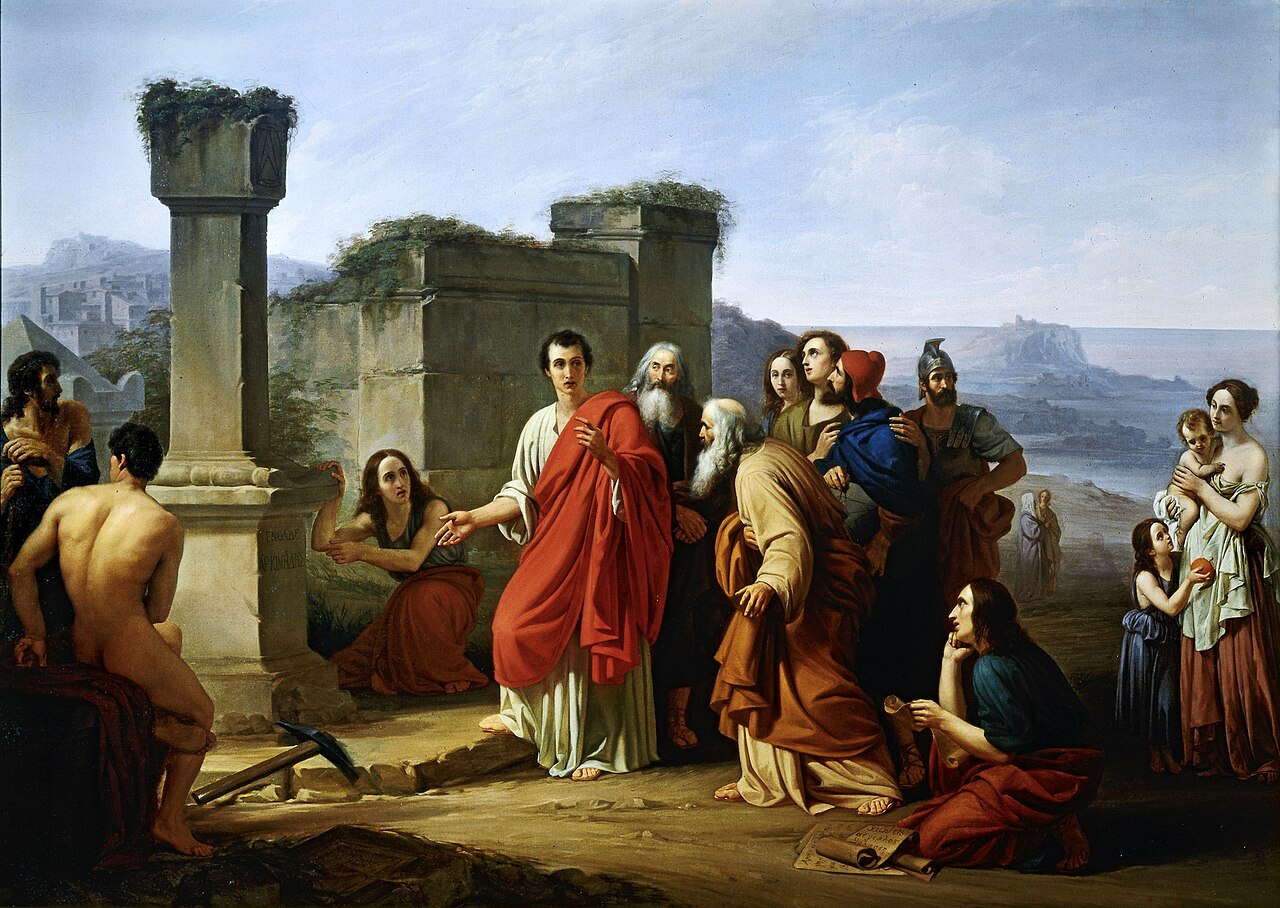
According to Plutarch, Archimedes desired that his tomb should be marked by a cylinder enclosing a sphere and an inscription of the ratio of the one to the other;5 Cicero related how he had sought out Archimedes’ tomb and found a column just so inscribed.6
M. Dehn. ‘The Mentality of the Mathematician: A Characterization’. In: The Mathematical Intelligencer. 5, no. 2 (June 1983), pp.21–2. DOI: 10.1007/bf03023621. ↩
Archimedes. The Works of Archimedes, vol. I: The Two Books on the Sphere and the Cylinder. Translated into English, together with Eutocius’ commentaries, with commentary, and critical edition of the diagrams. Cambridge University Press, 2004. ISBN: 978-0-521-66160‑7. ↩
I. Schneider. Archimedes: Ingenieur, Naturwissenschaftler, Mathematiker. 2nd edition. Mathematik im Kontext. Springer Spektrum. ISBN: 978-3-662-47129‑6. pp. 89-90 ↩
A. J. Cain. Form & Number: A History of Mathematical Beauty. Lisbon, 2024. pp. 106–7. ↩
Plutarch. ‘Marcellus’. In: Lives, vol. V. Loeb Classical Library, no. 87. Cambridge, MA: Harvard University Press, 1917. ISBN: 978-0-674-99097‑5. DOI: 10.4159/DLCL.plutarch-lives_marcellus.1917. Stephanus p. 307; § XVII.7. ↩
Cicero. Tusculan Disputations. Loeb Classical Library, no. 141. Cambridge, MA: Harvard University Press, 1927. DOI: 10.4159/DLCL.marcus_tullius_cicero-tusculan_disputations.1927. § V.xxv. ↩
Cone/sphere/cylinder from Form & Number, figure 3.9.
Paolo Barbotti, Cicero discovering the tomb of Archimedes. [Public domain]
.jpeg)