
4 February 2026
As noted in a previous post, Archimedes (c. 287–212 BCE) thought highly of the result that the ratio of either the volumes or surface areas of a cone, a sphere, and a cylinder exactly circumscribing them is $1:2:3$.
So did others: three centuries later, the architect Nicon (d. 149/50 CE), father of the philosopher and physician Galen (129–c. 210/217 CE), thought it fitting to point out the ratio of the configuration in a public inscription in his city, Pergamon:
‘the cone, the sphere, the cylinder.
If a cylinder encloses the other two shapes,
[…]
Competition the principle and in solids
the progression $1 ∶ 2 ∶ 3$,
a noble, divine equalization,
but also mutual interdependence
of the solids, always in the ratio $1 ∶ 2 ∶ 3$.
They should be beautiful and wonderful,
the three solid shapes’12
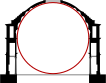
Nicon doubtless admired these ratios as an architect: a sphere inside a cylinder brings to mind the Pantheon at Rome, of which the Temple of Zeus Asclepius Soter in Pergamon was a half-scale copy. These buildings were designed so that a basically cylindrical rotunda was crowned with a hemispherical dome under which a sphere would fit.3
M. Fränkel, ed. ‘Altertümer von Pergamon’, vol. VIII.2: ‘Die Inschriften von Pergamon’. Berlin: W. Spemann, 1895. DOI: 10.11588/diglit.916. p. 246. ↩
E. Thomas. From Text to Building: the Impact of the Timaeus on the Discipline of Architecture in Later Antiquity’ In: J. Prins & E. Thomas, eds. Legacy of Plato’s Timaeus: Cosmology, Music, Medicine, and Architecture from Antiquity to the Seventeenth Century. Brill’s Studies in Intellectual History, no. 353. Leiden & Boston: Brill, 2024. ISBN: 978-90-04-43108‑9. DOI: 10.1163/9789004705838_006. ↩
A. J. Cain. Form & Number: A History of Mathematical Beauty. Lisbon, 2024. p. 108. ↩