
11 February 2026
Islamic geometrical art is justly famous for its mathematical beauty. Here I will point to some documented connections between the artisans who created it and mathematicians.
The mathematician Abū’l-Wafāʾ al-Būzjānī (940–77/8 CE) wrote in a book on geometry useful for craftsmen (more on this later) that he had been present at discussions between artisans and geometers. Al-Khayyāmī (Omar Khayyam; c. 1048–c. 1131), the father of algebra, wrote of attending such a meeting. Caʿfer Efendi ( fl. early 17th century) wrote of discussions between ‘learned men’ and architects on the subject of geometry.1
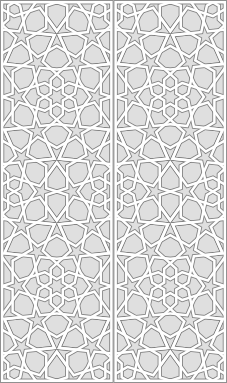
Another connection is in the person Abu’l-Faḍl ibn ʿAbd al-Karīm (d. 1202/3), whom Ibn abi Uṣaybiʿah recorded as having been called ‘the geometrician’ for his famed knowledge of geometry.2 He was by profession a carpenter and stonemason. He studied Euclid to improve his carpentry; he then proceeded to Ptolemy’s ‘Almagest’ and became an authority in geometry. His skill is evident in the doors he made for the Bīmaristān Nūr al-Dīn in Damascus, which have upon them a geometrical pattern of hexagons and pentagrams made up of brass nails (the design is shown in the image).3
Abū’l-Wafāʾ wrote the practical ‘Book on What the Artisan Requires of Geometrical Constructions’ to describe geometrically correct procedures of practical use, because (1) artisans often made geometrical errors, and (2) geometers were sometimes unsuccessful in extracting an applicable method from a correct theoretical solution.4
For example, artisans had asked how to construct a square with area three times a given square. To the theorist, this problem meant constructing a square with side length $\sqrt{3}$, and it was easy to give a theoretical solution. But the artisans were not satisfied: they desired to see three squares of side length $1$ dissected and re-assembled into a single square.4
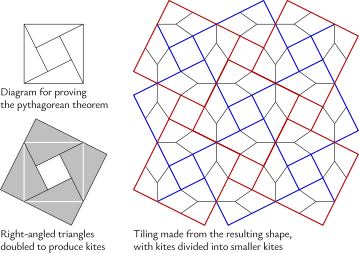
At the same discussion, he showed the artisans a proof of the pythagorean theorem. The diagram he used (see image) seems to have been admired by the artisans, for it was incorporated into architecture, such as on the western and northern ʾīwānāt of the Jāmeh Mosque of Isfahan and the Imam Ibrahim Mosque in Mosul. This diagram could be used to generate an ornamental pattern by doubling the right-angled triangles to form kites, dividing the kites, and then repeating the diagram.1
A. Özdural. ‘Omar Khayyam, Mathematicians, and “Conversazioni” with Artisans’. In: Journal of the Society of Architectural Historians. 54, no. 1 (March 1995), pp. 54–71. URL: https://www.jstor.org/stable/991025. pp. 54–5. ↩ ↩2
Ibn Abī Uṣaybiʿah. A Literary History of Medicine: The ʿUyūn al-anbāʾ fī ṭabaqāt al-aṭibbāʾ. Ed. by E. Savage-Smith, S. Swain & G. J. van Gelder. Leiden: Brill, 2020. ISBN: 978-90-04-41031‑2. DOI: 10.1163/37704_0668IbnAbiUsaibia.Tabaqatalatibba.lhom-tr-eng1. § 15.33. ↩
A. J. Cain. Form & Number: A History of Mathematical Beauty. Lisbon, 2024. pp. 220–5. ↩
G. Necipoğlu ‘Ornamental Geometries: A Persian Compendium at the Intersection of the Visual Arts and Mathematical Sciences’. In: G. Necipoğlu, ed. The Arts of Ornamental Geometry: A Persian Compendium on Similar and Complementary Interlocking Figures. Studies and Sources in Islamic Art and Architecture. Supplements to Muqarnas, no. XIII. Leiden & Boston: Brill, 2017. ISBN: 978-90-04-30196‑2. DOI: 10.1163/9789004315204_003. p. 24–5. ↩ ↩2