
12 February 2026
Luca Pacioli’s (c. 1445–1517) book Divina proportione (written 1496–8, published 1509) is famous in the history of mathematical beauty, but mostly for the wrong reasons.1
The term ‘divine proportion’ refers to Euclid’s ‘extreme and mean ratio’, known since the late 18th century as the ‘golden ratio’: $1.61803\ldots:1$.
Pacioli’s use of the term ‘divine’ was not based upon aesthetic appreciation.1
Rather, he made a mystical identification of certain properties of the ratio with attributes of God. For example, the incommensurability of the ratio corresponded to the indefinability and ineffability of God.1
But Pacioli aesthetically admired the five regular polyhedra — the platonic solids — and the archimedean solids that he knew.2 In the dedication of ‘Divina proportione’ he wrote that hoped that his patron would see ‘their most sweet harmony’. He linked the aesthetic value of the solids to that of the sphere, from which he saw them as deriving. He seems to have placed special value on the ‘most noble’ dodecahedron.3
In his portrait, a dodecahedron sits on top of one of his books as a symbol of mathematical success. His diagram is part of the construction of the tetrahedron. A glass rhombicuboctahedron hangs behind him.4
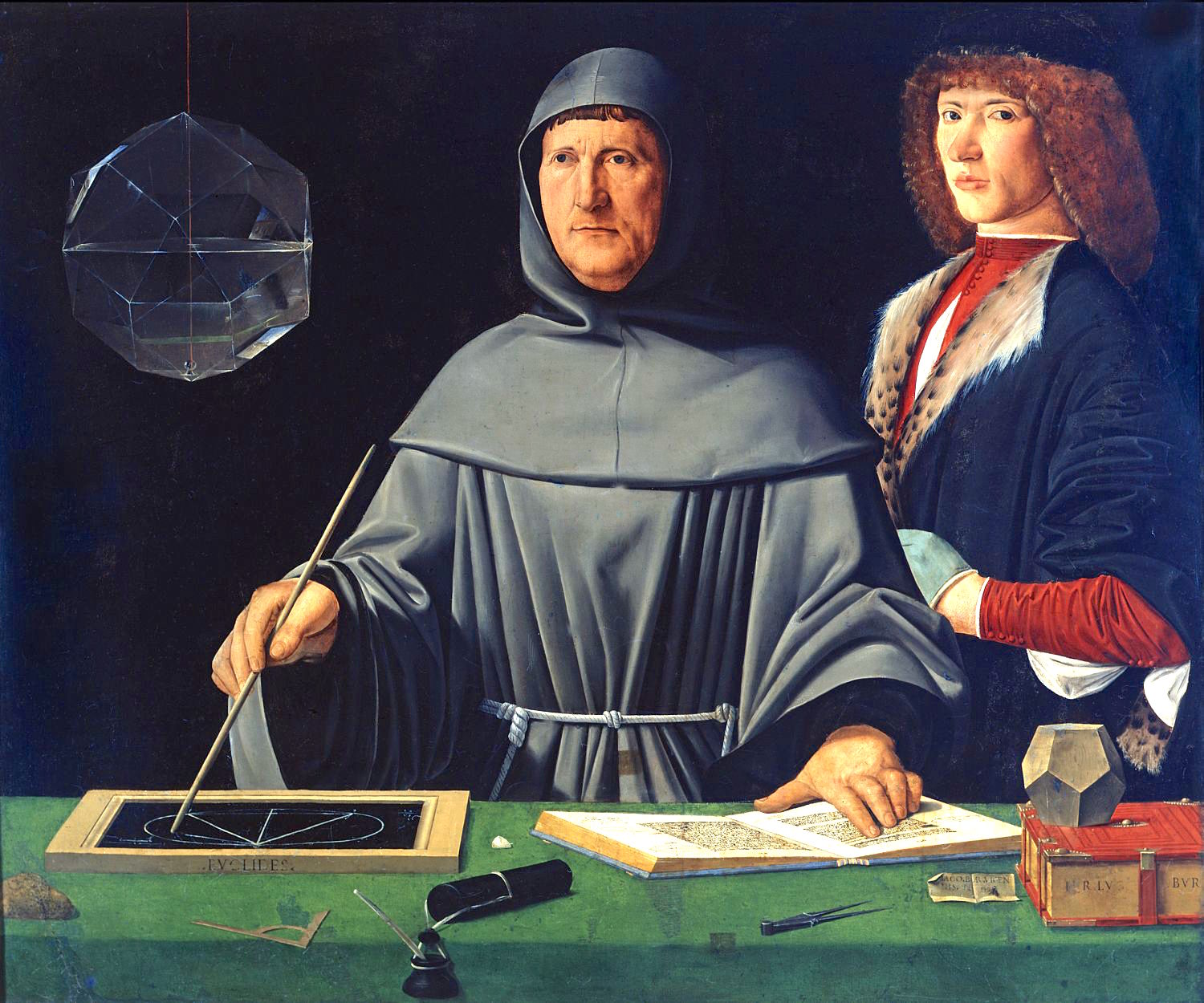
Pacioli did not give an explicit reason for thinking the dodecahedron ‘most noble’, but he did point out how simply and symmetrically the other regular solids can be inscribed in the dodecahedron:
the icosahedron is its dual and thus can be inscribed so that each of its vertices touches the centre of a face;
the octahedron can be inscribed so that each of its vertices touches the midpoint of an edge;
the cube and tetrahedron can be inscribed so that each of their vertices touches a vertex.3
Whatever the basis for the aesthetic value of the solids, he was sure it was rational. In his book, an epigram in the form of the solids addressing the reader says:
‘The sweet fruit, charming and pleasant,
Already forced the philosophers to seek
Our origins, to nourish the intellect.’3
A. J. Cain. Form & Number: A History of Mathematical Beauty. Lisbon, 2024. pp. 247–50, 550–8. ↩ ↩2 ↩3
N. Andrews. The Polyhedrists: Art and Geometry in the Long Sixteenth Century. Cambridge, MA & London: The MIT Press, 2022. ISBN: 978-0-262-04664‑0. ↩
L. Pacioli. Divina proportione. Venice: A. Paganius Paganinus, 1509. n.fol., fols 2r, 3v–4r. ↩ ↩2 ↩3
N. MacKinnon. ‘The Portrait of Fra Luca Pacioli’. In: The Mathematical Gazette. 77, no. 479 (July 1993), pp. 130-219. URL: https://www.jstor.org/stable/3619717. ↩
