
13 February 2026
The thirteen archimedean solids are the polyhedra (other than the five regular solids) all the faces of which are regular polygons and where for each pair of vertices some symmetry transformation carries one vertex to the other.
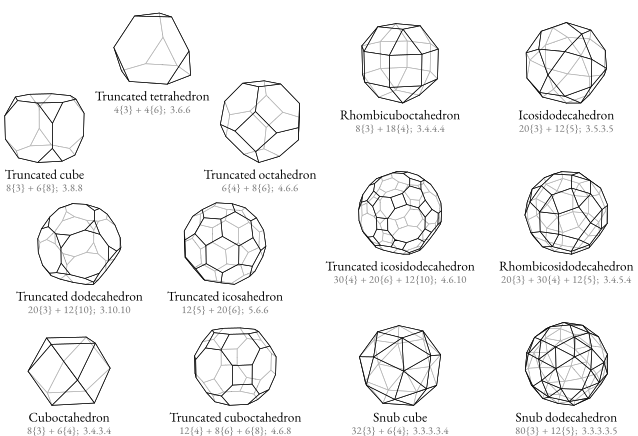
According to Pappus ( fl. c. 300–c. 350 CE), who wrote a half-millennium later, Archimedes (c. 287–212 BCE) discovered them.12 The context of Pappus’ report suggests that Archimedes was seeking polyhedra inscribable in spheres.
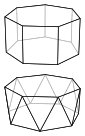
Archimedes excluded the infinite classes of prisms and anti-prisms, in which two $n$-gons are joined by squares or equilateral triangles. Although they satisfy the definition, and are technically inscribable in spheres, they are somehow not ‘sphere-like’.3
This suggests that Archimedes may have been influenced by the aesthetic preference for circles and spheres that descended from Pythagoras.3
The archimedean solids were gradually rediscovered during the Renaissance (see chart). First various truncations of the regular solids were considered. The artist Albrecht Dürer (1471–1528) seems to have considered what combinations of faces can fit around a vertex and so rediscovered the snub cube (which, like the snub dodecahedron, cannot be obtained by simple truncation of a regular solid). He also emphasized that he sought solids inscribable in spheres.3
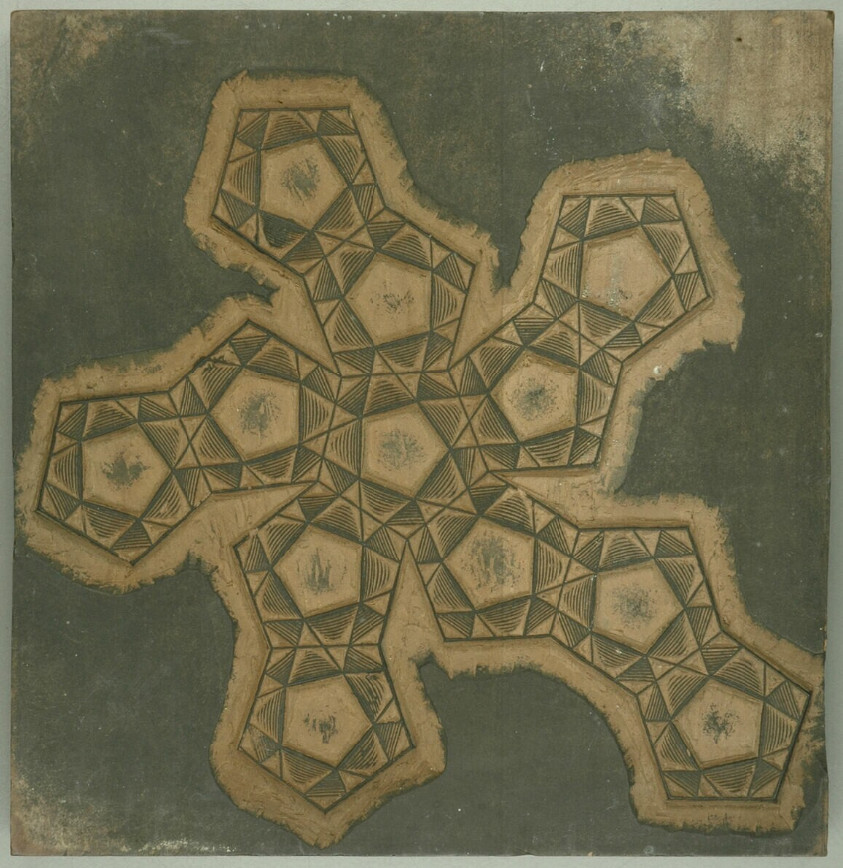
A set of anonymous printing blocks (the example of a snub dodecahedron in shown) from the mid-16th century shows that someone knew all thirteen archimedean solids, but examination has determined that the block were never used for printing an edition and so they presumably had no influence at the time.4
The complete list of archimedean solids was given by Johannes Kepler (see image), who called them ‘perfect of an inferior degree’. He excluded the prisms and anti-prisms as ‘imperfect’. Why? Because they were ‘discus-shaped, like a plane, not globe-shaped, like a sphere’.5
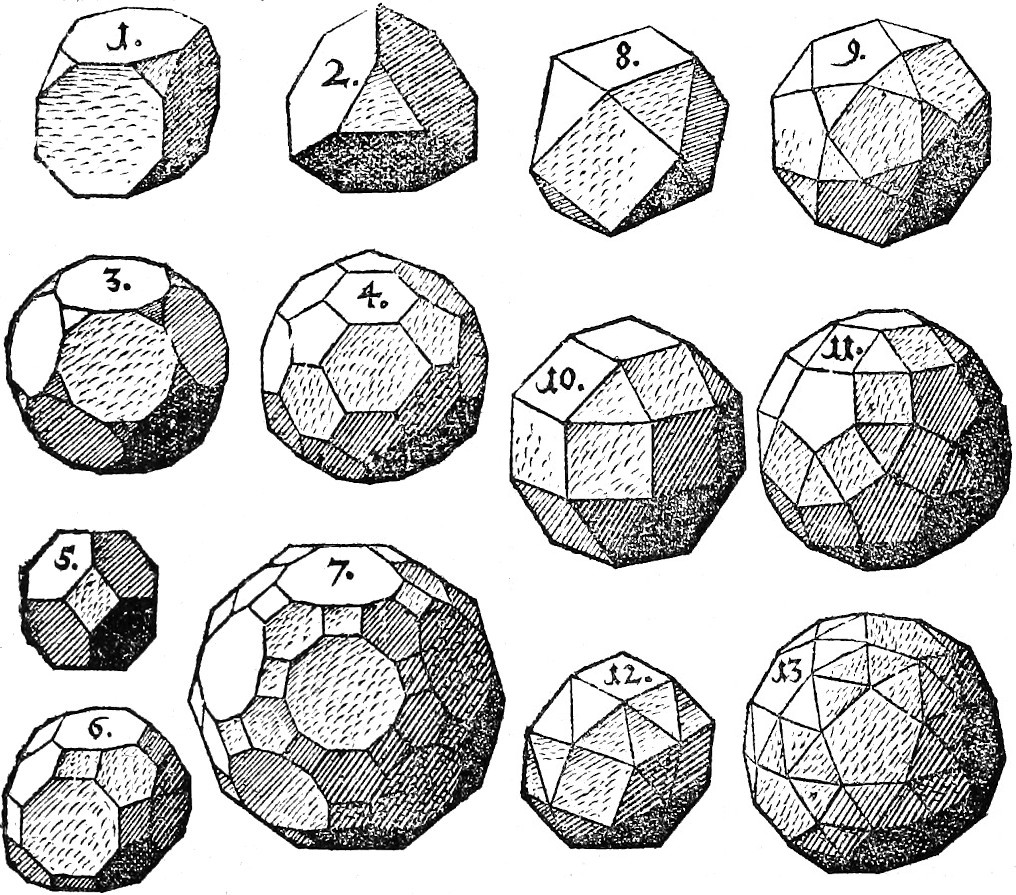
Thus Kepler’s study of polyhedra, like that of Archimedes before him, was tinged by a preference for the sphere.3
(For brevity, I have elided the difference between the definition of the archimedean solids by symmetry and the weaker ‘local’ condition of having the same configuration of faces at each vertex, which is also satisfied by the pseudo-rhombicuboctahedron. See the paper by Grünbaum for details.6)
Pappus. La Collection Mathématique. Paris & Bruges: Desclée de Brouwer et Cie, 1933. § V.xix. ↩
E. J. Dijksterhuis. Archimedes. Princeton University Press, 1987. ISBN: 978-0-691-08421‑3 pp. 405–8. ↩
A. J. Cain. Form & Number: A History of Mathematical Beauty. Lisbon, 2024. pp. 110–2, 236–6, 252–3, 258–9, 290–2. ↩ ↩2 ↩3 ↩4
P. Schreiber, G. Fischer & M. L. Sternath. ‘New light on the rediscovery of the Archimedean solids during the Renaissance’. In: Archive for History of Exact Sciences. 62, no. 4 (July 2008), pp.457-467. DOI: 10.1007/s00407-008-0024-z. ↩
J. Kepler. Gesammelte Werke, vol. VI: Harmonice Mundi. Ed. by M. Caspar & F. Hammer. Munich: C. H. Beck, 1940. bk II, § xxviii. ↩
B. Grünbaum. ‘An enduring error’. In: Elemente der Mathematik. 64, no. 3 (2009), pp. 89–101. DOI: 10.4171/EM/120. ↩
Diagrams of archimedean solids and prisms and chart of rediscovery from Form & Number, figures 3.11, 3.12, 3.13, 8.1.
Printing block: ‘Netz des Dodekaeders mit Angabe der Abstumpfung zum abgeflachten Dodekaeder’. Albertina. Inventory number HO2006/723. URL: https://sammlungenonline.albertina.at/objects/287259/netz-des-dodekaeders-mit-angabe-der-abstumpfung-zum-abgeflac [Public domain].
Kepler’s diagrams: https://archive.org/details/ioanniskepplerih00kepl/page/n87 https://archive.org/details/ioanniskepplerih00kepl/page/n85 [Public domain].