
14 February 2026
Book XVI of Girolamo Cardano’s (1501–76) De Subtilitate, a compendium of natural philosophy, begins by presenting sixty useful properties of geometrical figures, and says:
‘These are the sixty properties, outstanding in distinction and beauty and regard [nobilitate, & pulchritudine, & admiratione præstantiores], of the geometrical figures both surface and solid. Yet it does not escape me that properties exist that are practically numberless, but cannot be compared with these for elegance’.1
Some of the properties Cardano so admired seem to lapse into triviality, but others are important results from Euclid, Archimedes, Apollonius, and Ptolemy. For example:
Let $A_i$ be the point at the end of the $i$-th turn of an archimedean spiral. Consider the line through the $A_i$ and the perpendicular to this line through the origin $O$. Suppose that the tangent to the spiral at $A_i$ intersects the perpendicular at $B_i$ . Then $OB_i$ equals the circumference of the circle with centre $O$ and radius $OA_i$.
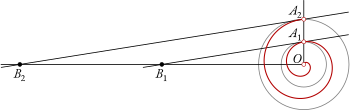
This result effectively comprises Propositions 18 and 19 of Archimedes’ On Spirals.2
Cardano’s discussion of sensory beauty in De Subtilitate suggests that he thought that the appreciation of beauty was connected with cognition and involved qualities such as symmetry which can be found also in mathematics:
‘every sense especially enjoys what it recognises. […] So what is beauty? A thing perfectly recognised by vision — we cannot love what is not recognised. […] when vision immediately grasps the equality and symmetry […], it is delighted’.1
This may be why Cardano aesthetically praised properties of figures rather than abstract theorems: for him, aesthetic value was bound up with the visual configuration.3
G. Cardano. De Subtilitate. Edited by J. M. Forrester. Medieval and Renaissance Texts and Studies, no. 436. Tempe, AZ: Arizona Center for Medieval and Renaissance Studies, 2013. ISBN: 978-0-86698-484‑3. p. 707. ↩ ↩2
Archimedes. The Works of Archimedes, vol. II: On Spirals. Translated into English, with commentary, and critical edition of the diagrams. Cambridge University Press, 2017. ISBN: 978-0-521-66145‑4. ↩
A. J. Cain. Form & Number: A History of Mathematical Beauty. Lisbon, 2024. pp. 265–7. ↩