
15 February 2026
François Viète (= Franciscus Vieta; 1540–1603) Viète described as ‘elegant and very beautiful [elegans & perpulchræ]’ the result shown here in the original Latin and using his original notation:1
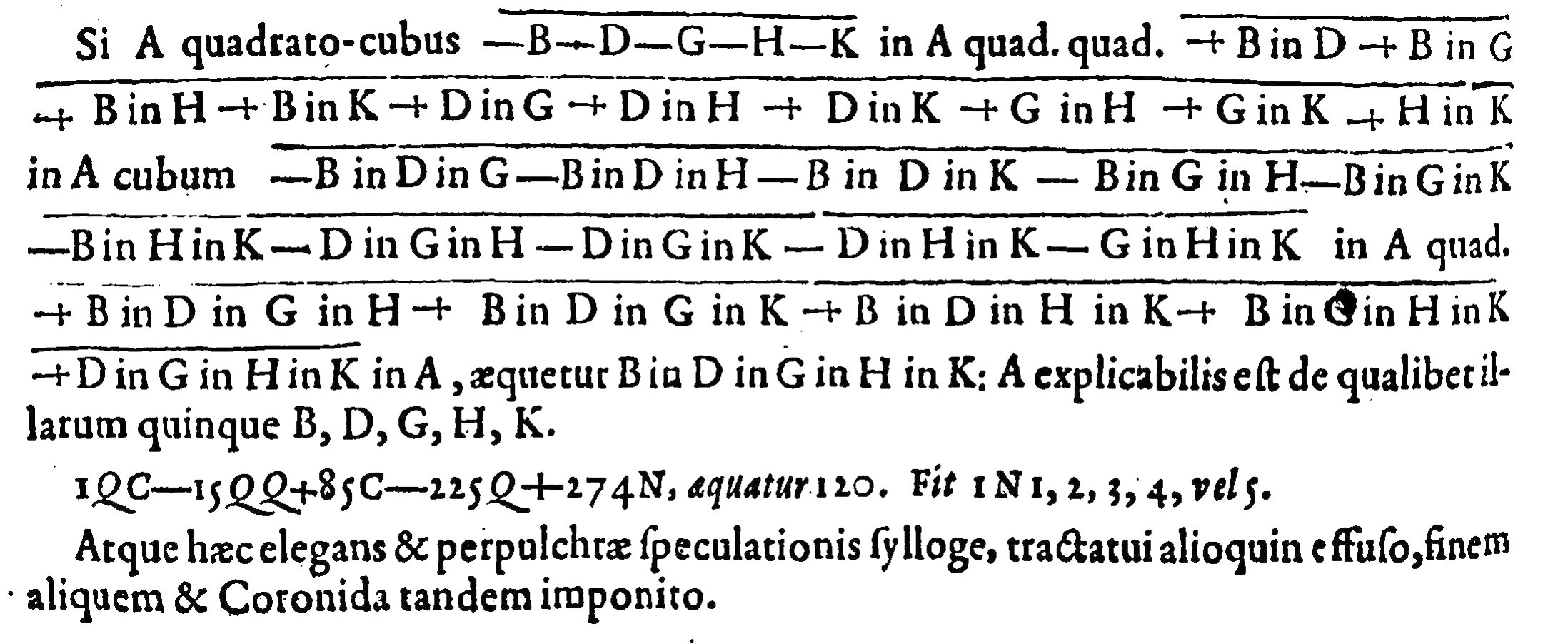
Translated into English and into modern algebraic notation, Viète’s result says:
If, for an unknown $a$ and known $b$, $d$, $g$, $h$, and $k$, and the equality $a^5 - a^4(b+d+g+h+k) + a^3(bd + bg + bh + bk + dg + dh + dk + gh + gk + hk) - a^2(bdg+ bdh + bdk + bgh + bgk + bhk + dgh + dgk+ dhk + ghk) + a(bdgh + bdgk + bdhk + bghk + dghk) = bdghk$ holds , then $a$ is either $b$, $d$, $g$, $h$, or $k$.
A mathematician today, working with this modern notation, would presumably notice that if one sets $a = b$ and multiplies out the brackets on the left hand side, all terms except $bdghk$ cancel; by symmetry, the same reasoning applies for $d$, $g$, $h$, $k$.2
Thus, to modern eyes, the result collapses into near-triviality and seems to deserve little if any aesthetic praise. Perhaps the notation Viète had to work with made the result seem more mysterious and thus more aesthetically pleasing.2
There are scattered other references to aesthetic value throughout Viète’s ‘Opera’.2
At least one result seems to have earned lasting aesthetic appreciation. Going beyond Archimedes’ inscription of a $96$-gon in a circle to approximate $\pi$, Viète considered inscribing $4$, $8$, $16$, and in general $2^n$-gons and derived the infinite product
\[ \frac{2}{\pi} = \frac{\sqrt{2}}{2}\cdot\frac{\sqrt{2 + \sqrt{2}}}{2}\cdot\frac{\sqrt{2 + \sqrt{2 + \sqrt{2}}}}{2}\cdots, \]
which Eli Maor judged to be
‘a remarkable formula, one which even today arouses our admiration for its beauty’.3
F. Vietæ. ‘De Emendatione Æqvationvm Tractatus Secundus’. In: Opera Mathematica. Edited by F. à Schooten. Leiden: Ex Officinâ Bonaventuræ & Abrahami Elzeviriorum, 1646. p. 158. ↩
A. J. Cain. Form & Number: A History of Mathematical Beauty. Lisbon, 2024. pp. 271–3. ↩ ↩2 ↩3
E. Maor. To Infinity and Beyond: A Cultural History of the Infinite. Princeton University Press, 1991. ISBN: 978-0-691-02511‑7 p. 10. ↩