
17 February 2026
Evangelista Torricelli’s (1608–47) solid is defined by rotating the hyperbola $y = 1/x$ about the $x$ axis and truncating it at $x=1$ (see diagram).
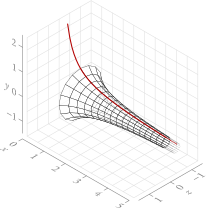
It has infinite length and infinite surface area but finite volume.
This counter-intuitive discovery caused philosophical disturbance, for it seemed to violate the distinction between finite and infinite.12
Torricelli, foreseeing the scrutiny to which his work would be subjected, took the precaution of preempting some criticisms by supplying two different proofs, one by ‘indivisibles’, one by exhaustion.
But René Descartes (1596–1650) seems not to have been provoked to any philosophical objections and thought that Torricelli’s discovery was beautiful.3
Henry Needler ( fl. 1690–1718), a perhaps slightly obscure figure who foreshadowed 18th-century discussions of the sublime, seemed to be impressed by the solid’s ‘Grandeur and Magnificence’ and thought that it would ‘afford the greatest Delight and Satisfaction to curious Minds’.45
(Today, Torricelli’s solid is also called ‘Gabriel’s horn’ or ‘Torricelli’s trumpet’.)
A. J. Cain. Form & Number: A History of Mathematical Beauty. Lisbon, 2024. pp. 302–4. ↩
P. Mancosu & E. Vailati. ‘Torricelli’s Infinitely Long Solid and Its Philosophical Reception in the Seventeenth Century’. In: Isis. 82, no. 1 (March 1991). DOI: 10.1086/355637. ↩
Descartes, letter to de Beaune, dated 20 Feb. 1639, repr. in Œuvres. Ed. by C. Adam & P. Tannery. Paris: Léopold Cerf, 1897/1913. vol. IV, p. 553. ↩
H. Needler. ‘On the excellency of divine contemplation’. In: A. Ashfield & P. de Bolla, eds The sublime: a reader in British eighteenth-century aesthetic theory. Cambridge University Press, 1996. ISBN: 978-0-521-39545‑8. p. 80. ↩
Cain, Form & Number, p. 1001. ↩