
18 February 2026
An enduring locus of mathematical beauty in the seventeenth century concerned curves like the cycloid and the catenary.1
A cycloid is the path followed by a point on the circumference of a circle rolling along a straight line (see attached image).
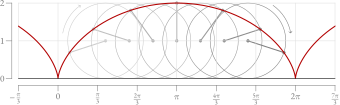
Christopher Wren (1632–1723) proved that the arc length of the cycloid is four times the diameter of its generating circle.1
Christiaan Huygens (1629–95) thought Wren’s work ‘beautiful’.2 Blaise Pascal (1623–62) also called it ‘beautiful’3 (even though he also seemed to repudiate any true notion of mathematical beauty in his ‘Pensées’.4
Huygens proved that an inverted cycloid was the ‘tautochrone’: the curve along which a body starting from rest and freely accelerated by uniform gravity reaches the lowest point in the same time, independently of its starting point.
Johann Bernoulli (= Jean; 1667–1748) posed the problem of finding the ‘brachistochrone’: the curve between two points along which a body starting from rest at the higher point and freely accelerated by uniform gravity would descend in minimum time to the lower.
Gottfried Wilhelm Leibniz (1646–1716) thought the problem beautiful; so did Guillaume de l’Hospital (1661–1704).1
Bernoulli (and others) proved that the brachistochrone was again an inverted cycloid. He thought that the equality of the cycloid, tautochrone, and brachistochrone curve would leave his readers ‘petrified with astonishment’, and thought that it suggested some deep design in nature.5
One of Bernoulli’s proofs was what he considered a ‘very beautiful’ geometric demonstration that the cycloid was the brachistochrone. But he did not publish it until 20 years later. Why? Apparently in part due to Leibniz, who had thought it so beautiful and extraordinary that he counselled against publication, with the aim of ‘so frustrating those who are not very grateful and who are accustomed to profiting from the inventions of others’.6
Here, mathematical beauty contributed to the suppression, albeit temporary, of mathematical knowledge.
A. J. Cain. Form & Number: A History of Mathematical Beauty. Lisbon, 2024. pp. 295–6, 305, 329–31. ↩ ↩2 ↩3
C. Huygens, letter to van Schooten, dated 7 Feb. 1659, repr. in Œuvres Complètes. The Hague: Martinus Nijhoff, 1888/1950. vol. 2, p. 343. ↩
B. Pascal. ‘Histoire de la Roulette’. In: Œuvres, vol. VIII. Ed. by L. Brunschvicg, P. Boutroux & F. Gazier. Paris: Hachette, 1914. p. 204. ↩
B. Pascal. Pensées. Penguin, 2013. ISBN: 978-0-14-191564‑7. § 586. ↩
Joh. Bernoulli ‘On the Brachistochrone Problem’. In: A Source Book in Mathematics. Ed. by D.E. Smith. New York: Dover Publications, 1959. vol. 2, pp. 649, 654. ↩
Joh. Bernoulli, letter to Varignon, dated 27 Jul. 1697, repr. in Der Briefwechsel. DOI: 10.1007/978-3-0348-5067-4. vol. 2, p. 117. ↩