
19 February 2026
Gottfried Wilhelm Leibniz’s (1646–1716) first great mathematical achievement was the ‘arithmetic quadrature’ of the circle through his alternating series: $\pi/4 = 1 - 1/3 + 1/5 - 1/7 + 1/9 - 1/11 + \ldots$.1
He communicated the result to his mathematical mentor Christiaan Huygens (1629–95), who thought it ‘very beautiful and very pleasing’.2 Isaac Newton (1642–1726) welcomed Leibniz’s work as ‘very elegant’.3 Leibniz himself wrote that there was no simpler or more beautiful way of expressing the area of a circle using rational numbers.4
In a short note concerning the beauty of theorems, Leibniz wrote:
‘Theorems are not intelligible except by their signs or characters. […] The beauty of theorems consists in the beautiful arrangement of their characters.’5
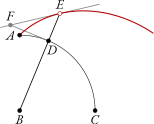
To illustrate ‘beautiful arrangement of characters’, Leibniz gave the example of a theorem concerning Berthet’s curve (shown in red in 1st attached image). The detail of its definition is not important here, but it is defined with reference to an arc $AC$ centred at $B$.6
Leibniz’s result was a way of finding the tangent to the curve at $E$: take the tangent to the arc at its intersection with $BE$ (i.e., at $D$), and find the point $F$ such that $FD ∶ DE ∶∶ EB ∶ BD$. Then $EF$ is the desired tangent.
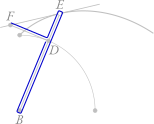
Why is there a ‘beautiful arrangement of characters’? Because the proportion $FD ∶ DE ∶∶ EB ∶ BD$ is easily remembered via a mnemonic: one can draw the path $FD \cdot DE \cdot EB \cdot BD$ without raising one’s pen:
E.J. Aiton. Leibniz: A Biography. Bristol & Boston: Adam Hilger, 1985. ISBN: 978-0-85274-470‑3. pp. 49–52. ↩
Huygens, letter to Leibniz, dated 6 Nov. 1674, repr. in Leibniz, Sämtliche Schriften und Briefe. Berlin: Akademie-Verlag. vol. III.1, p. 170. ↩
Newton, letter to Oldenburg, dated 24 Oct. 1676, repr. in ‘Correspondence’. Ed. by H. W. Turnbull, J. F. Scott, A. R. Hall & L. Tilling. London, New York & Melbourne: Cambridge University Press, 1959/1977. vol. 2, pp. 110, 120–1 [trans. pp. 130, 139; ltr 188]; Iliffe & Mandelbrote, ‘Newton Project’, NATP00196. ↩
Leibniz, letter to [Kochański], dated Jul.–Aug. 1680, repr. in Sämtliche Schriften und Briefe’. vol. III.3, p. 243 [ltr 91] (cf. p. 37, [ltr 2]). ↩
Leibniz, ‘De la Beauté des Théorèmes’. In Sämtliche Schriften und Briefe. vol. VII.5, ch. 63, p. 439. ↩
A.J. Cain. Form & Number: A History of Mathematical Beauty. Lisbon, 2024. pp. 332–4. ↩