
20 February 2026
Results ranging from visualizable theorems of solid geometry to abstract propositions of analysis were called beautiful by Leonhard Euler (1707–83). For instance, he thought beautiful the following result:1
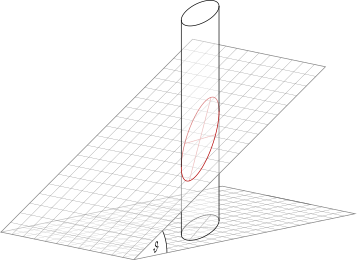
If an elliptical cylinder is cut by any plane at an angle $\vartheta$, then the ratio of the product of the principal axes of the section and of the product of the principal axes of the base is $1:\cos\vartheta$.
Aesthetic concerns seem to have been part of what drew Euler to number theory. Christian Goldbach (1690–1764) persuaded him to take an interest in the subject and to make a serious study of Fermat’s work. His attention was drawn by the theorem:
Every natural number can be expressed as a sum of four squares.
With presumably deliberate understatement, Euler described it as a ‘not inelegant theorem’.2 The result remained unproven in Euler’s time, and the first proof was given by Joseph-Louis Lagrange (1736–1813), becoming known as ‘Lagrange’s four-square theorem’.
Thus, for Euler, unproven conjectures could have aesthetic value.3 And so he judged another well-known then-unproven result of Fermat:
‘In Fermat there is another very beautiful theorem for which he claims to have found a proof. […] the formula $a^n + b^n = c^n$ is impossible whenever $n > 2$’.4
L. Euler, Opera Omnia, vol.I.8–9: Introductio in Analysin Infinitorum. Ed. by A. Speiser. B. G. Teubner, Orell Füssli, Birkhäuser, 1922/45. ISBN: 978-3-7643-1407‑1. URL: http://euler.lettre.digital/ p. 357. ↩
Euler, letter to Goldbach, dated 15 Jun. 1730, repr. in Opera Omnia. B. G. Teubner, Orell Füssli, Birkhäuser, 1911/. URL: http://euler.lettre.digital/ vol. IV.A.4.I, p. 113 [ltr 6, trans. vol.IV.A.4.II, p. 603]. ↩
A.J. Cain. Form & Number: A History of Mathematical Beauty. Lisbon, 2024. pp. 332–4. ↩
Euler, letter to Goldbach, dated 4 Aug. 1753, repr. in Opera Omnia. vol. IV.A.4.I, p. 534 [ltr 169, trans. vol. IV.A.4.II, p. 1091]. ↩