
21 February 2026
The idea that the ‘golden’ ratio — $1.61803\ldots:1$ — has applications in visual art and architecture does not go back any further than the 2nd edition (1799–1802) of Jean-Étienne Montucla’s (1725–99) (generally superb) ‘Histoire des Mathématiques’, in which he made the incorrect statement that Luca Pacioli’s (c. 1447–1517) book ‘Divina Proportione’ included illustrations of the ratio’s application to architecture and font design.12
This was shortly after the earliest known appearance of the term ‘golden section’ in Johann Samuel Traugott Gehler’s (1751–95) general scientific dictionary ‘Physikalisches Wörterbuch’.23
The golden ratio was then taken up by Adolph Zeising (1810–76) as the basis for a system of aesthetic proportion in his book ‘New Theory of the Proportions of the Human Body’ (1854), where he argued — apparently to his own satisfaction — that his system agreed with the proportions of many masterpieces of art.4
The psychologist Gustav Fechner (1801–87) made a much-misreported experiment in which people were asked to choose the most aesthetically pleasing of various rectangles (shown in the attached image). The most popular choice was the $34 ∶ 21$ rectangle, whose proportions approximate the golden ratio. Fechner’s conclusion was only that a range of rectangles, including the golden ratio rectangle, were considered most pleasing.5
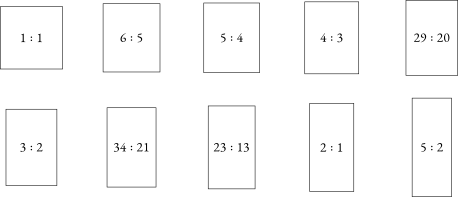
Fechner added:
‘I cannot help but find the aesthetic value of Zeising’s golden ratio to be overestimated, although I do not deny the interest and merit of Zeising’s discovery, that this ratio has a noteworthy aesthetic value’6 (emphasis added)
Fechner was careful to distinguish the supposed visual aesthetic superiority of the golden ratio from its role in mathematics. Although he mistakenly believed that the term ‘golden’ went back to antiquity, he thought that this terminology indicated only its special role in mathematics.7
He explicitly acknowledged that there was no extant historical evidence for it having had any aesthetic significance.
The idea that the golden ratio was prominent in art took hold in the early 20th century, when it was incorporated into theories of proportion by authors such as the artist Jay Hambidge (1867–1924) and the philosopher Matila Ghyka (1881–1965).28 The architect Le Corbusier (1887–1965), influenced by Ghyka, started to use the golden ratio in his designs and even tried to rewrite history by publishing drawings indicating that he had used the golden ratio in buildings he had designed using different systems.9
J.-É. Montucla. Histoire des Mathématiques. New edition. Paris: Henri Agasse, 1799/1802. vol. 1, p. 551. ↩
A. J. Cain. Form & Number: A History of Mathematical Beauty. Lisbon, 2024. pp. 552–7. ↩ ↩2 ↩3
J. S. T. Gehler. Physikalisches Wörterbuch. Leipzig: Schwickert, 1787/1801. vol. 2, p. 120. ↩
A. Zeising. Neue Lehre von den Proportionen des menschlichen Körpers. Leipzig: Rudolph Weigel, 1854. ↩
G. T. Fechner. Vorschule der Aesthetik. Leipzig: Breitkopf & Härtel, 1876. vol. 1, p. 192, §§ e), f), g). ↩
Fechner, Vorschule der Aesthetik, vol. 1, p. 194. ↩
G. T. Fechner. ‘Zur experimentellen Aesthetik’. In: Abhandlungen der Mathematisch-Physischen Classe der Königlich-Sächsischen Gesellschaft der Wissenschaften. 9 (1871), pp. 553–636. ↩
R. Herz-Fischler. ‘A Mathematical History of the Golden Number’. Mineola: Dover, 1998. ISBN: 978-0-486-40007‑5. ↩
R. Fischler. ‘The early relationship of Le Corbusier to the “golden number”’. In: Environment and Planning B: Planning and Design. 6, no. 1 (1 March 1979), pp. 95–103. DOI: 10.1068/b060095. ↩