
22 February 2026
In retrospect, modern aesthetics is seen to have emerged at the end of the 17th and in the 18th centuries, with the term ‘aesthetic’ being coined by Alexander Gottlieb Baumgarten (1714–62) in 1735 from the Greek aisthētikos [αἰσθητικός].
Many of the early thinkers considered mathematical beauty to be an archetypical form of beauty and integrated it into their theories.
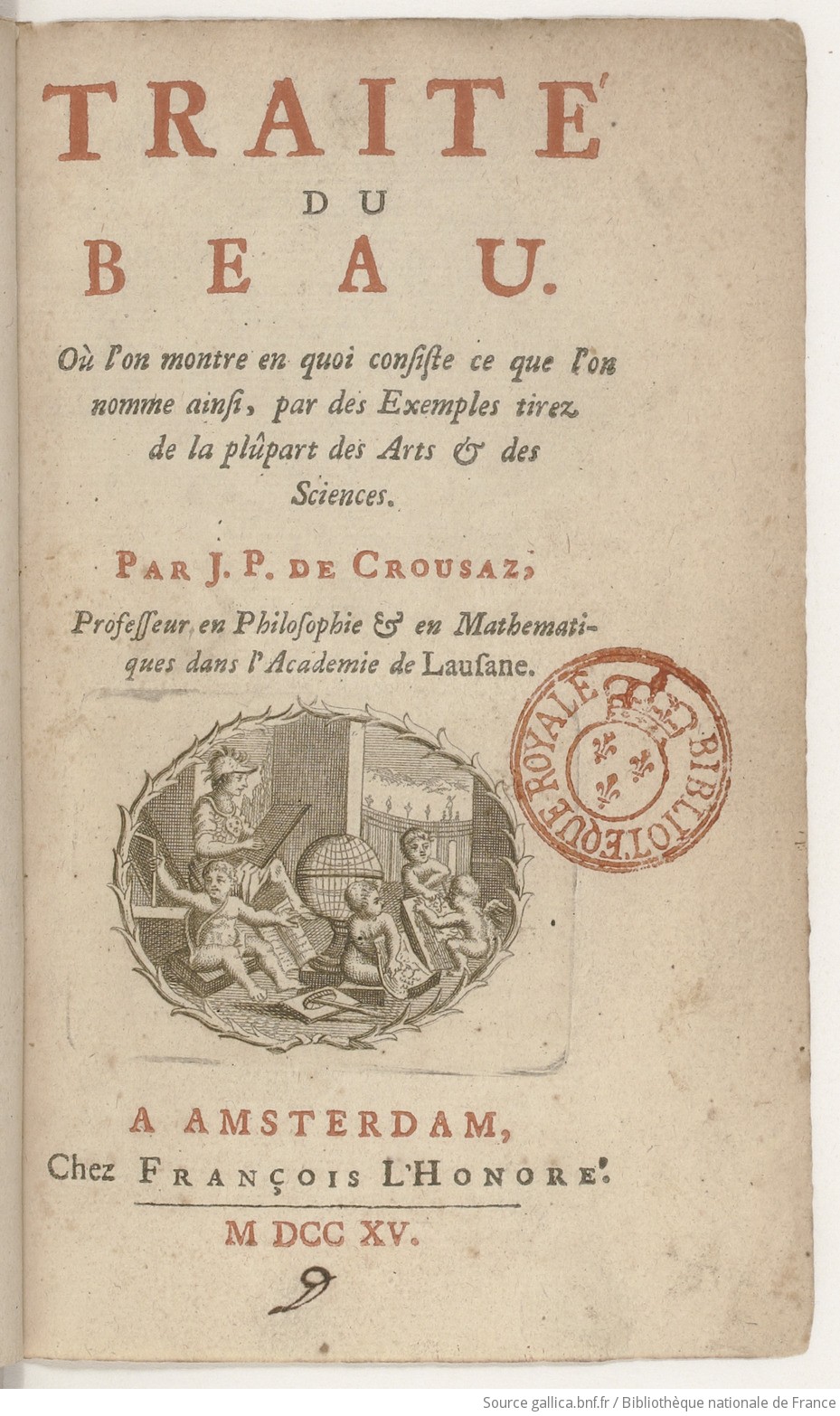
For example, Jean-Pierre de Crousaz (1663–1750)1 and Francis Hutcheson (1694–1746) both analysed beauty in terms of ‘unity (or uniformity) amidst variety’. Hutcheson thought that this explained why regular polyhedra were more beautiful than irregular ones, and that Archimedes’ celebrated theorem
The ratios of volumes of a cylinder, its inscribed sphere, and a cone of equal base and height are $3 ∶ 2 ∶ 1$
was more beautiful than the less precise
A cylinder has greater volume than an inscribed sphere, which in turn has greater volume than a cone of equal base and height
because they had equal variety (since they applied to the same objects), but the first theorem had greater unity.2
![The start of Diderot's article on ‘Beautiful’ [‘BEAU, adj. (Métaphysique)’] in the Encyclopédie. Text begins: ‘BEAU, adj. (Métaphysique.) Avant que d’entrer dans la recherche difficile de l’origine du beau, je remarquerai d’abord, avec tous les auteurs qui en ont écrit, que par une sorte de fatalité, les choses dont on parle le plus parmi les hommes, sont assez ordinairement celles qu’on connoît le moins ; & que telle est, entre beaucoup d’autres, la nature du beau. Tout le monde raisonne du beau : on l’admire dans les ouvrages de la nature : on l’exige dans les productions des Arts : on accorde ou l’on refuse cette qualité à tout moment ; cependant si l’on demande aux hommes du goût le plus sûr & le plus exquis, quelle est son origine, sa nature, sa notion précise, sa véritable idée, son exacte définition ; si c’est quelque chose d’absolu ou de relatif ; s’il y a un beau essentiel, éternel, immuable, regle & modele du beau subalterne ; ou s’il en est de la beauté comme des modes…’](files/2026-02-22-diderot-beau.jpg)
Denis Diderot (1713–84) criticized Hutcheson’s application of uniformity amidst variety to geometrical objects and to theorems in his article on ‘Beautiful’ [‘BEAU, adj. (Métaphysique)’] in the Encyclopédie.3
Diderot preferred the system of Yves-Marie André (1675–1764), whose book Essai sur le Beau4 was famous in its time. André thought that in mathematics there was an essential geometrical beauty that was prior even to God and which had been used in the creation of the world. André saw beauty as a motivation for mathematicians from Euclid and Archimedes to Kepler and Huygens:
‘In a word, there is no academy in Europe where the love of mathematical beauty has not given in our days new conquests to the kingdom of truth.’
The attention paid to mathematical beauty in philosophical aesthetics seems to have dwindled in the 19th century with the domination in aesthetics of the philosophy of art, rather than of beauty, especially under G. W. F. Hegel’s (1770–1831) influence.5 It revived in the first half of the 20th century in the work of philosophers like David Wight Prall (1886–1940) and Louis Arnaud Reid (1895–1986).678
J. P. de Crousaz. Traité du Beau. Amsterdam: François L’Honoré, 1715. ↩
F. Hutcheson. An Inquiry Concerning Beauty, Order &c.. In: An Inquiry into the Original of Our Ideas of Beauty and Virtue in Two Treatises. Ed. by W. Leidhold. Indianapolis: Liberty Fund, 2004. ISBN: 978-0-86597-428‑9. Art. III.iv. ↩
D. Diderot. ‘Beau’. In: Encyclopédie, ou Dictionnaire Raisonné des Sciences, des Arts et des Métiers. vol. 2. Ed. by D. Diderot & J. le R. d’Alembert. Paris, 1752. ↩
Y.-M. André. Essay on Beauty. Trans. from the French and annotated by A. J. Cain. Porto: Ebook, 2010. ↩
Cain. Form & Number. ch. 11. ↩
Cain. Form & Number. ch. 20. ↩
D. W. Prall. Æsthetic Judgement. New York: Thomas Y. Crowell Company, 1967. ↩
L. A. Reid. A Study in Aesthetics. London: George Allen & Unwin, 1931. ↩
Crousaz, Traité du Beau. Gallica, Bibliothèque Nationale de France. URL: https://gallica.bnf.fr/ark:/12148/bpt6k1510777m [Public domain].
L’Encyclopédie. vol. 2. L’Institut de France. URL: https://bibnum.institutdefrance.fr/ark:/61562/mz2085 [Public domain].