
23 February 2026
Joseph-Louis Lagrange (1736–1813) found mathematical beauty in many of the fields in which he worked.1 Here I present some examples from solid geometry.
He considered beautiful Albert Girard’s (1595–1632) theorem relating the area and the angles of a spherical triangle: The area of a triangle $ABC$ on the surface of a unit sphere is $A + B + C − \pi$.
Jean-Étienne Montucla (1725–99) had earlier called the result ‘very elegant’, but had complained that Girard had proved it in a ‘quite laborious and obscure’ fashion.2 Lagrange thought John Wallis’s (1616–1703) proof was beautiful.3
Another result that Lagrange admired was the following:
In any stereographic projection of a sphere onto a plane, any circle on the sphere that does not pass through the point of projection is projected to a circle on the plane.
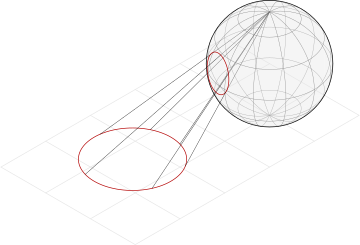
Hence to find the image of such a circle under projection it suffices to find the images of three distinct points on the circle. This fact Lagrange thought a ‘beautiful property of the stereographic projection’.4
A. J. Cain. Form & Number: A History of Mathematical Beauty. Lisbon, 2024. p. 392–400. ↩
J.-É. Montucla. Histoire des Mathématiques. New edition. Paris: Henri Agasse, 1799–1802. vol. 2, p.8. ↩
Lagrange. ‘Solutions de quelques Problèmes relatifs aux triangles sphériques, avec une analyse complète de ces triangles’. In: Œuvres, vol. 7. Ed. by J.-A. Serret. Paris: Gauthier-Villars, 1867–92. p. 337. ↩
Lagrange. ‘Sur la construction des Cartes géographiques’. In: Œuvres, vol. 4. p. 639. ↩