
25 February 2026
The mathematical theory of linkages was once found beautiful, but is now comparatively unknown.1
One of its highlights was what Florian Cajori (1859–1930) called the ‘beautiful discovery’ of the Peaucellier–Lipkin linkage (found independently in 1864 and 1871), a simple mechanism that transforms circular motion into linear motion (see image).2
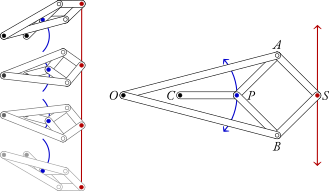
The importance of such a mechanism is that it can produce straight-line motion without using guide-rails and thus reducing friction. Previous linkages such as James Watt’s (1736–1819) only approximated straight-line motion.1
J. J. Sylvester, (1814–97) (who characterized his mathematical work as ‘the worship of the True & Beautiful’3) admired a pump based on the linkage for ‘[i]ts elegance, and the frictionless ease with which it can be worked (beauty as usual the stamp and seal of perfection)’.4
When the physicist William Thomson (later Baron Kelvin; 1824–1907) was able to work a model of the linkage, he was reluctant to hand it back, saying: ‘No! I have not had nearly enough of it — it is the most beautiful thing I have seen in my life’.
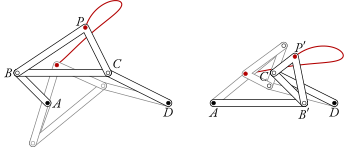
Sylvester also thought beautiful Alfred Bray Kempe’s (1849–1922) result that two linkages of three pieces draw out the same curves up to similarity if the lengths of the pieces are the same (see image).5
Kempe himself thought that the then-recent developments in the mathematical theory of linkages were of ‘great beauty’, and were valuable, but that they were not important. They would have been important a half-century earlier, when they would have helped the progress that engineering had been forced to make without them.6
A. J. Cain. Form & Number: A History of Mathematical Beauty. Lisbon, 2024. pp. 438–40. ↩ ↩2
F. Cajori. A History of Mathematics. 2nd edition. New York: Macmillan, 1919. p. 301. ↩
J. J. Sylvester, letter to Joseph Henry, dated 12 Apr. 1846, repr. in K. H. Parshall. James Joseph Sylvester: Life and Work in Letters. Oxford University Press, 1998. ISBN: 978-0-19-850391‑0. p. 16. ↩
J. J. Sylvester ‘On Recent Discoveries in Mechanical Conversion of Motion’. In: The Collected Mathematical Papers. Ed. by H. F. Baker. Cambridge University Press, 1904/1912. vol. III. p. 10, n. *. ↩
J. J. Sylvester. ‘On the plagiograph aliter the skew pantigraph’. In: The Collected Mathematical Papers, vol. III. p. 30, n. † cont. from p. 29. ↩
A. B. Kempe. How to Draw a Straight Line: A Lecture on Linkages. Nature Series. London: MacMillan and Co., 1877. p. 6 ↩