
26 February 2026
The philosopher, biologist, and political theorist Herbert Spencer (1820–1903) has a minor but curious role in the history of mathematical beauty, because of comments he made about Monge’s theorem,1 which states:
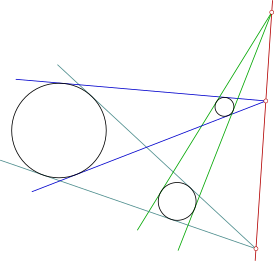
For any three circles in a plane, none contained within another, the intersections of the outside tangents of the three pairs of circles are collinear.2 (See attached image.)
Spencer said that when he thought of it he was
‘struck by its beauty at the same time that it excites feelings of wonder and of awe: the fact that apparently unrelated circles should in every case be held together by this plexus of relations, seeming so utterly incomprehensible.’3
However, Spencer’s reaction of wonder and of awe may ultimately have been born of his limited mathematical ability.
Spencer expressed enthusiasm for mathematics, and was proud enough of a rather slender theorem he proved in 1840 to reprint the paper as an appendix to his autobiography.4 (The result had actually been known since the mid-18th century.5)
But his geometrical knowledge was actually quite limited, and the statement he gave of Monge’s theorem was carelessly imprecise.1
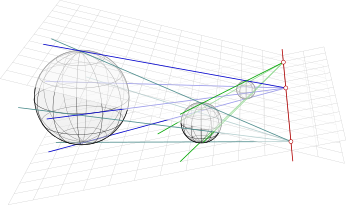
Further, Gaspard Monge’s (1746–1818) original proof is simple and explains the theorem:
Imagine the circles are great circles of three spheres. Then there are two planes that are tangent with all three spheres. (See attached image.) These planes are also in contact with the cones defined by each pair of spheres, and the tangent lines are where these cones pass through the original plane. Thus both these planes contain the apices of the three cones, which are the intersections of pairs of the tangents. That is, the intersection points lie in the intersection of the two planes, which is a straight line.2
A. J. Cain. Form & Number: A History of Mathematical Beauty. Lisbon, 2024. pp. 574–5. ↩ ↩2
G. Monge. *Géométrie Descriptive: Leçons Données aux Écoles Normales, l’An 3 de la République. Paris: Baudouin, 1798. § 44. ↩ ↩2
H. Spencer. An Autobiography. New York: D. Appleton and Company, 1904. vol. I, p. 187. ↩
H. Spencer. An Autobiography. vol. I, appendix B. ↩
J. S. Mackay. ‘Herbert Spencer and Mathematics’. In: Proceedings of the Edinburgh Mathematical Society. 25 (February 1906), pp.95–106. DOI: 10.1017/S0013091500033629. ↩