
27 February 2026
In 1948, François Le Lionnais (1901–84) published an essay in which he distinguished two types of beauty in mathematics:123
Classical mathematical beauty, which impressed by its control and austerity.
Romantic mathematical beauty, which manifested in wildness, non-conformity, and strangeness.4
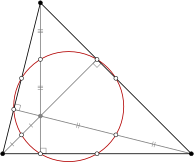
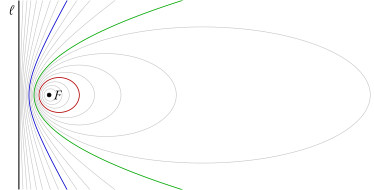
Classical beauty was found where there was unification, such as in the 9-point circle of a triangle (which passes through the three midpoints of the sides, the feet of the three altitudes, and the mid-points of the three segments between the orthocentre and the vertices), or how the circle, ellipse, hyperbola, and parabola all arise from the focus–directrix construction and from conic sections, and can transformed into one another by projective transformations.5
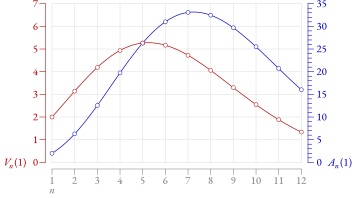
Romantic beauty could arise from unexpectedness, such as the formulae for the volumes and surface areas of $n$-dimensional unit spheres, namely \[ V_n(R) = \frac{\pi^{n/2}}{\Gamma(1+n/2)}R^n \quad \text{and} \quad A_n(R) = \frac{2\pi^{n/2}}{\Gamma(n/2)}R^{n-1}, \] reaching their maximums at non-integer values.6
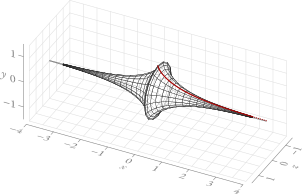
Another locus of romantic beauty was the tractroid pseudosphere, which is defined by rotating the tractrix defined by \[ x = \log\frac{1+\sqrt{1-y^2}}{y} - \sqrt{1-y^2} \] (shown in red for $x \geq 0$) about the $x$ axis. Its romantic beauty was due to it being in some ways close to the sphere, having constant Gaussian curvature (negative, while the sphere’s is positive), and the same surface area as the sphere, and finite volume (equal to half of the sphere), but was in other respects wild, having infinite extent.7
The cycloid had both classical beauty — in its simple definition — and romantic beauty — in its unexpected appearance as the solutions to the tautochrone and brachistochrone problems, contrary to intuition.8
A. J. Cain. Form & Number: A History of Mathematical Beauty. Lisbon, 2024. pp. 671–7. ↩
F. Le Lionnais. ‘La Beauté en Mathématiques’. In: F. Le Lionnais, ed. Les Grands Courants de la Pensée Mathématique. L’Humanisme Scientifique de Demain. Cahiers du Sud, 1948. ↩
F. Le Lionnais. ‘Beauty in Mathematics’. In: F. Le Lionnais, ed. Great Currents in Mathematical Thought, vol. 2. New York: Dover, 1971. ISBN: 978-0-486-62724‑3. (Note: translation is sometimes very free, and some quotations have been distorted by being translated from English to French and back.) ↩
F. Le Lionnais. ‘La Beauté en Mathématiques’. pp. 438–440, 444. ↩
F. Le Lionnais. ‘La Beauté en Mathématiques’. pp. 440–1, 449–50. ↩
F. Le Lionnais. ‘La Beauté en Mathématiques’. p. 448 ↩
F. Le Lionnais. ‘La Beauté en Mathématiques’. p. 462. ↩
F. Le Lionnais. ‘La Beauté en Mathématiques’. p. 446. ↩