
25 October 2025
The #Mathober 2025 day 25 prompt is ‘Wedge’, so I would like to point out a little historical curiosity involving ‘wedge’.
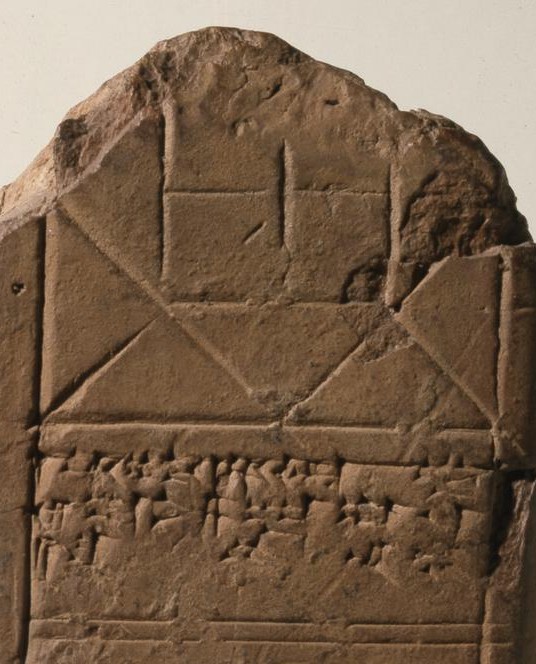
The images show a detail from an Old Babylonian clay tablet of geometrical problems and a reconstruction of the diagram.
The cuneiform text reads:
‘The square-side is 1 cable. ⟨Inside it⟩ I drew 12 wedges and 4 squares. What are their areas?’ (trans. Robson, ‘Mesopotamian mathematics’, p.95)1
The term ‘wedge’ translates the Akkadian ‘santakkum’, which names any figure with three (possibly non-straight) sides. (1 ‘cable’ = approximately 360 metres)
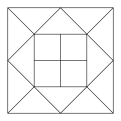
The exact symmetry of the configuration is vital to the problem. Without symmetry, which is suggested by the (necessarily approximate) diagram, but which is not made explicit in the question, the ‘wedges’ could be (e.g.) non-isosceles triangles of different sizes, and the problem would be insoluble.2
The problems on the tablet comprise various geometric configurations in which symmetry is implicitly required for the solution.
E. Robson. ‘Mesopotamian Mathematics’, p. 95. Ch. 2, pp. 57–186 in: V. Katz, ed. The Mathematics of Egypt, Mesopotamia, China, India, and Islam: A Sourcebook. Princeton University Press, 2007. ISBN: 978-0-691-11485‑9 ↩
A. J. Cain, Form & Number: A History of Mathematical Beauty (Lisbon, 2024), p. 34. ↩